Capsule
Heritage
Our grandmothers’ wear, in today’s reading.
One modern piece for every region of Uzbekistan, each based on a garment documented by museums and ethnographers. Monochrome, one colour per piece, in clean modern cuts: classic, semi-classic and semi-sport.
Eight regions, eight pieces
HR-01 · Fergana
Munisak gilet-coat
An ankle-length sleeveless gilet-coat: the wedge panels overlap at the waist, the edges are bound with a 1 cm tonal woven tape, with deep in-seam pockets.
Composition: 100% Uzbek cotton twill · recommended
Heritage source: Fergana munisak: a ceremonial swing robe whose wedge-shaped front panels overlap and leave the chest open; every edge is trimmed with woven ribbon.21
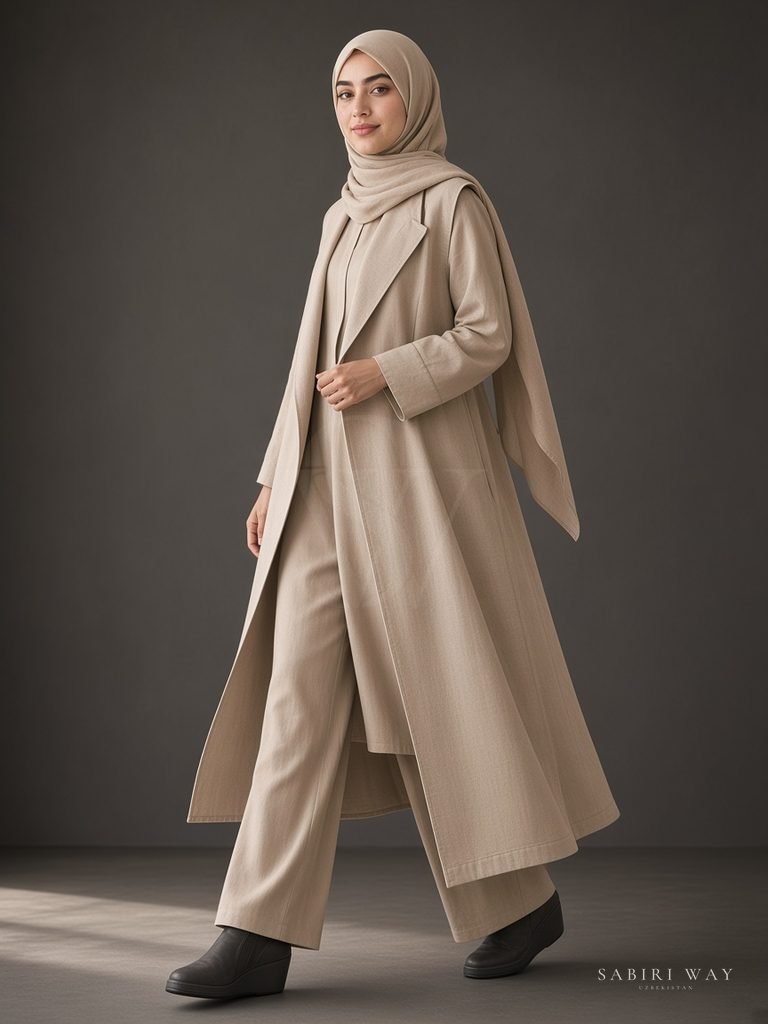
Stone BeigeClassicHR-02 · Bukhara
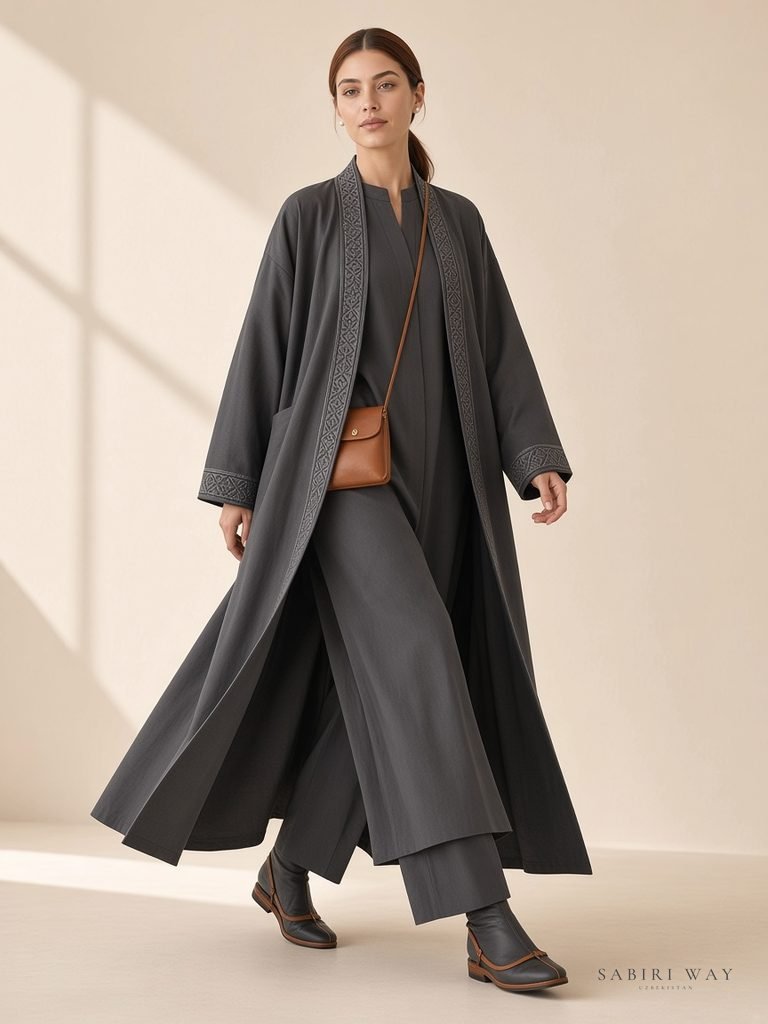
Kaltacha robe-coat
A straight ankle-length open robe-coat. Zardozi becomes a 4 cm band of tonal satin stitch along the front edges and cuffs: instead of gold, thread in the cloth’s own colour.
Composition: 70% wool / 30% cotton twill · recommended
Heritage source: Bukhara kaltacha: the women’s robe worn over the dress; it is kept in the Bukhara Museum collection, and festive versions were finished with zardozi gold embroidery.78
CharcoalClassicHR-03 · Khorezm
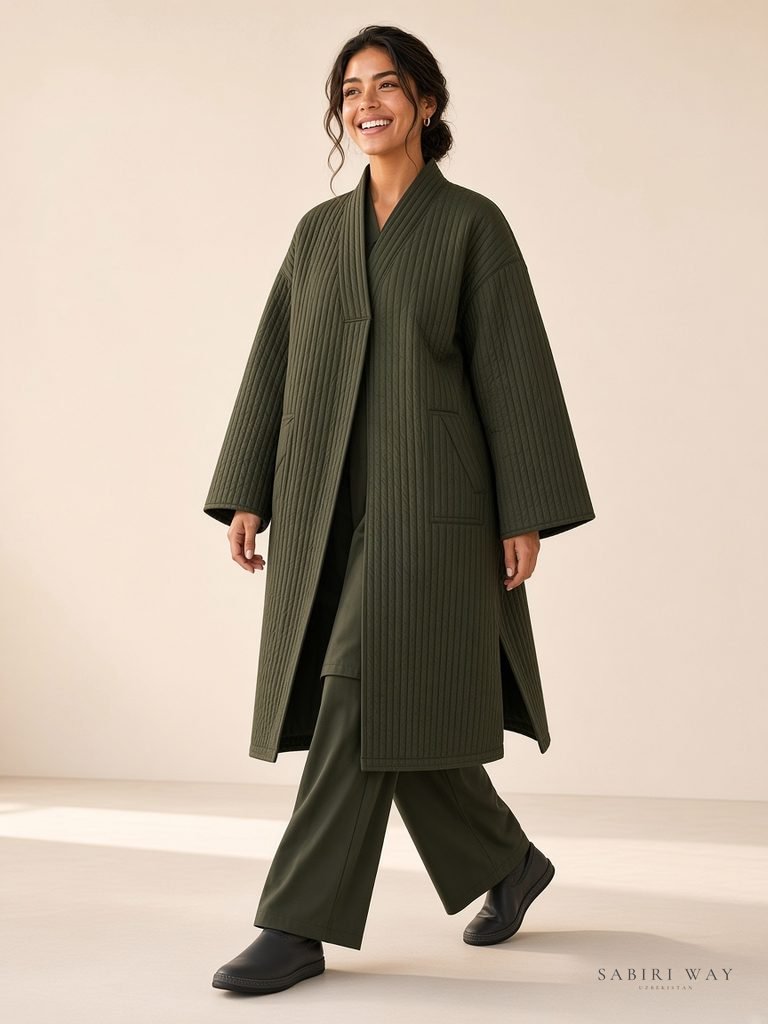
Yelak quilted coat
A knee-length oversize coat with vertical channel quilting every 1 cm, a collarless crossover front and sleeves that narrow to the wrist: a light semi-sport layer.
Composition: 100% cotton, PFC-free water-repellent finish · recommended
Heritage source: Khorezm yelak and misak: tunic-cut women’s coats on a thin layer of cotton wool, quilted with very small dense stitches 0.5–1 cm apart; the sleeve is wide at the base and narrow at the wrist.3
Dark OliveSemi-sportHR-04 · Samarkand
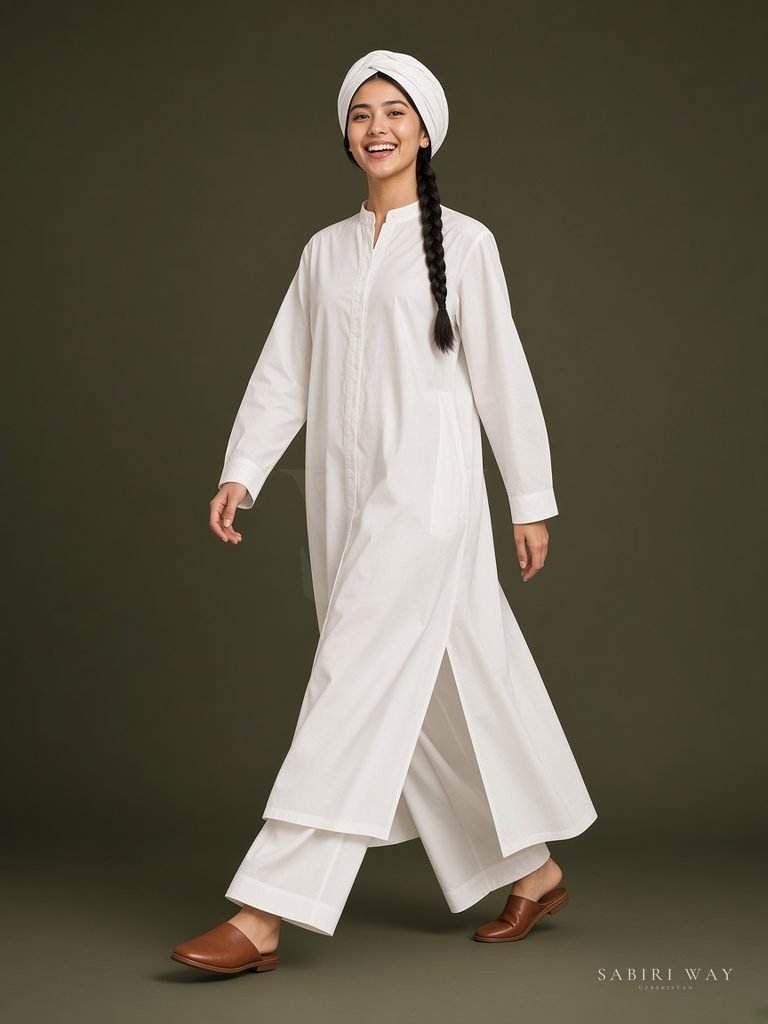
Peshkusho shirt-dress
An ankle-length shirt-dress with a waist-deep placket on covered buttons, tapered sleeves and underarm gussets for ease of movement.
Composition: 100% Uzbek cotton poplin · recommended
Heritage source: Samarkand ‘kurtai peshkusho’: a collarless dress with a vertical neck opening cut down to the waist; the Samarkand sleeve tapered to about 20 cm, with side pieces set under the sleeves.1
Cotton WhiteSemi-classicHR-05 · Surkhandarya
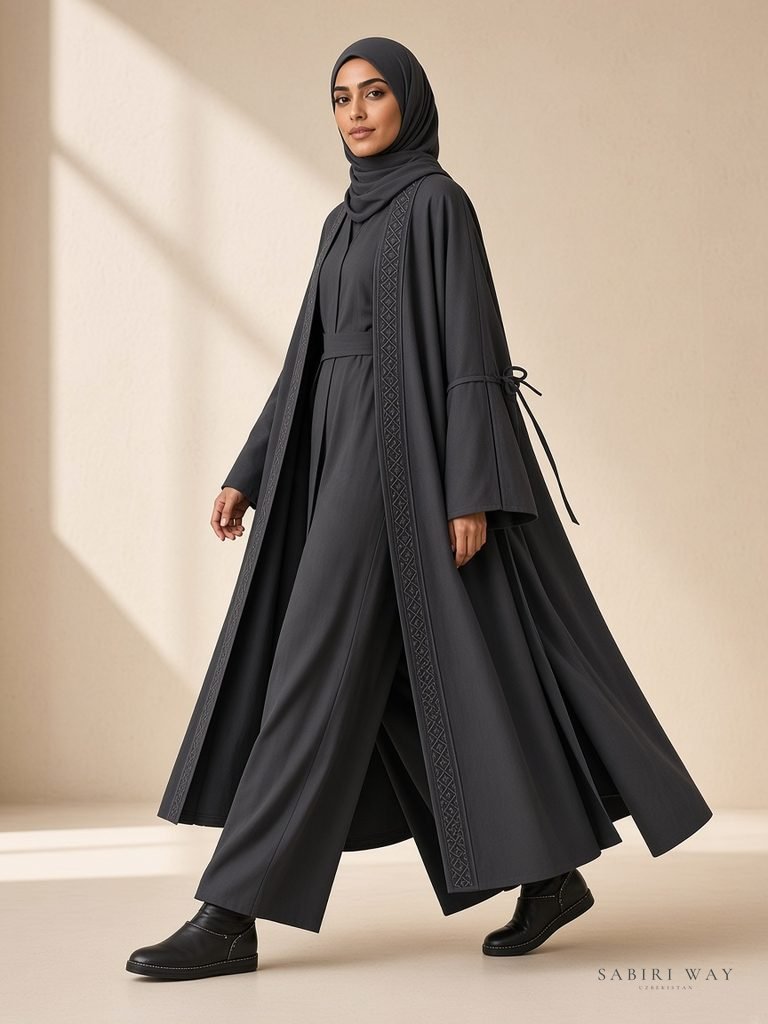
Jelak cape-coat
An unlined ankle-length cape-coat worn on the shoulders: the long false sleeves fall behind and tie with a thin cord; a narrow tonal embroidered band runs along the front edges.
Composition: 60% wool / 40% cotton crepe · recommended
Heritage source: Surkhandarya jelak and kurta: unlined outer robes worn over the head; their long sleeves were tied at the back, and the front edges were decorated with embroidery.56
CharcoalSemi-classicHR-06 · Kashkadarya
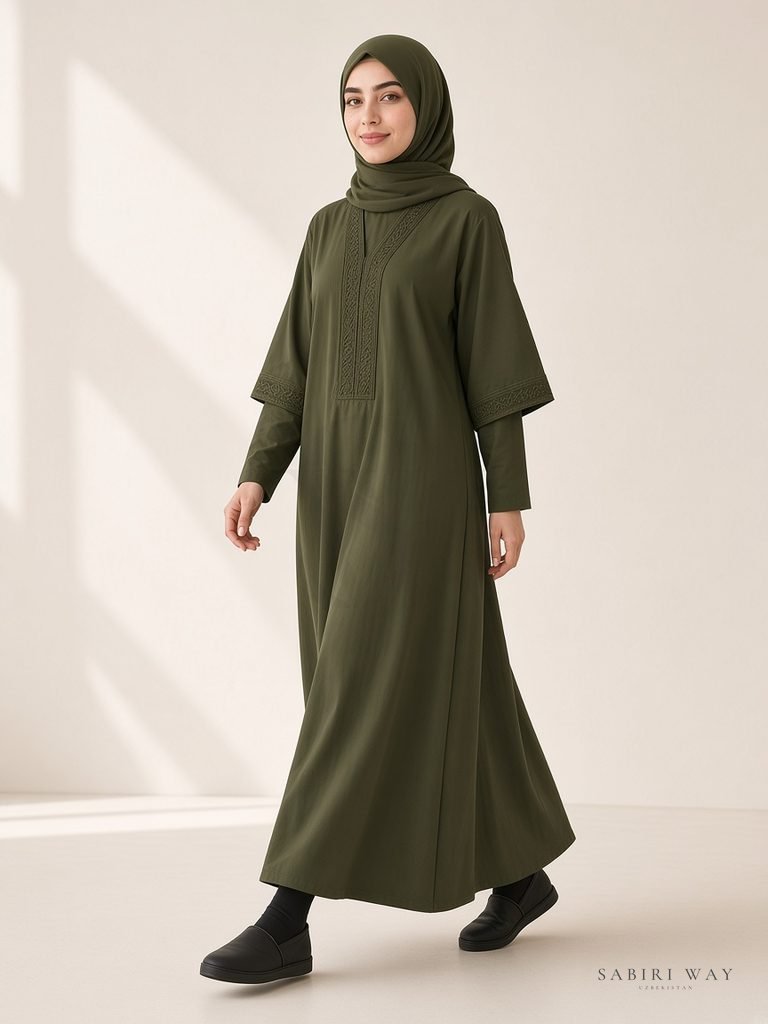
Two-layer dress
One ankle-length dress built as two layers: wide elbow-length over-sleeves above long narrow under-sleeves, and a double tonal embroidered band from the triangular neckline.
Composition: 100% Uzbek cotton sateen · recommended
Heritage source: Kashkadarya women wore several dresses at once: the long sleeves of the under-dress showed beneath the wider, shorter sleeves of the upper one, and a broad braid ran in two lines down from the neck.4
Dark OliveClassicHR-07 · Tashkent
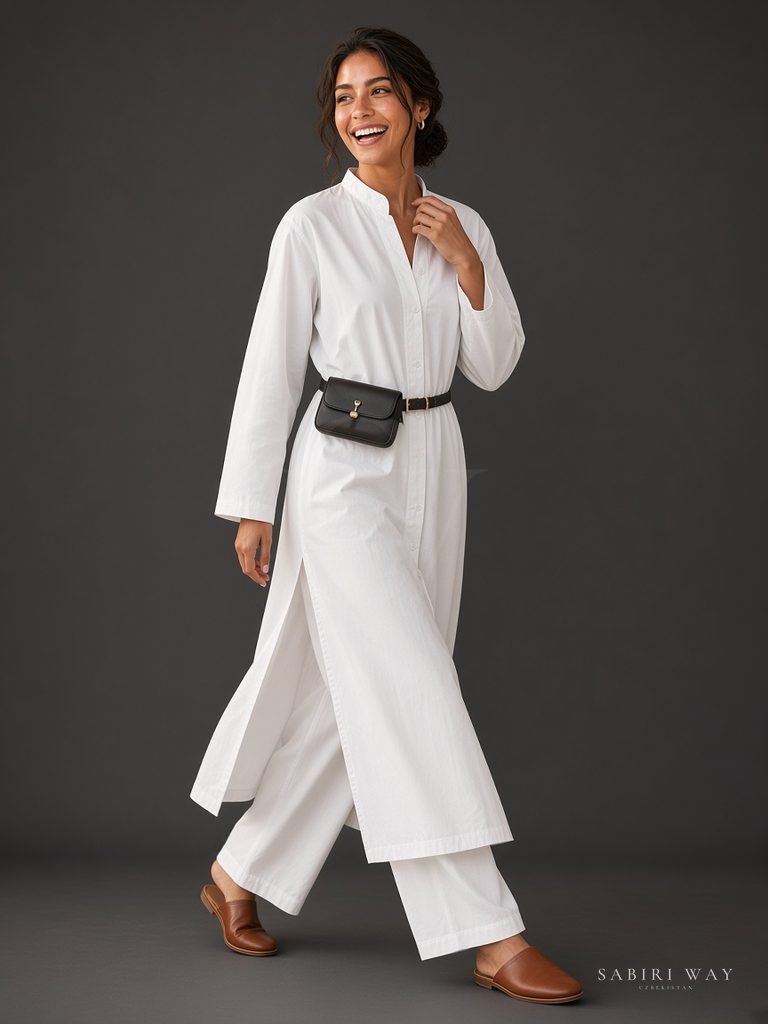
Yaktak dress
A light, unlined ankle-length robe-dress: a low stand collar, fabric loops and buttons to the waist and high side vents, worn over wide trousers.
Composition: 100% Uzbek cotton poplin · recommended
Heritage source: The yaktak is a light summer gown without lining, seen as early as the early medieval murals of Balalyktepa; by the late 19th century wrap-over yaktak shirts were popular with young and old. Tashkent women of that time wore a dress, wide trousers, a mursak or ton, and makhsi with galoshes.910
Cotton WhiteSemi-sportHR-08 · Karakalpakstan
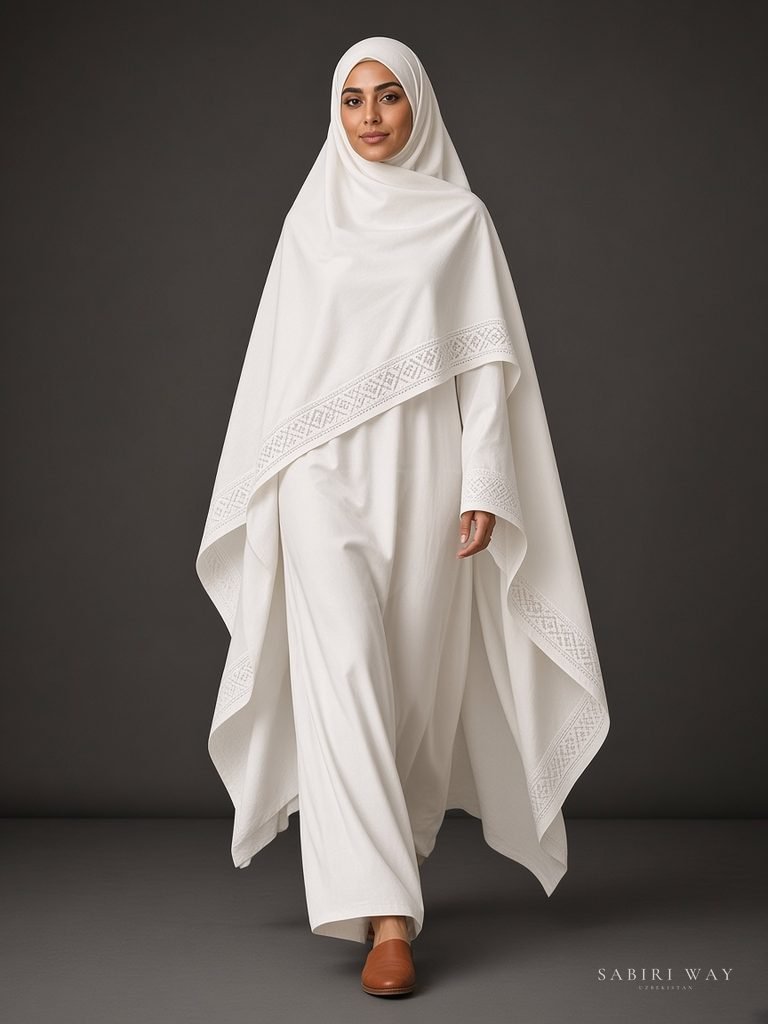
Aq jegde mantle
A large draped mantle for the head or shoulders: long narrow false sleeves at the back and a fine tonal cross-stitch geometric band along the front edges only.
Composition: 100% Uzbek cotton cambric · recommended
Heritage source: Karakalpak jegde: an unlined, robe-like mantle with long false sleeves, thrown over the head and shoulders when going out and at festivities; the white aq jegde, embroidered in cross stitch, was worn by older women.1112
Cotton WhiteClassic
Headwear, shawl, trousers and mahsi
HR-09 · Across Uzbekistan
Lozim wide trousers
Wide oversize trousers: flat front, elasticated back waist, two deep front pleats and side pockets; length to the ankle bone.
Composition: 98% cotton / 2% elastane twill · recommended
Heritage source: Lozim and ishtan: the wide trousers worn under the dress in every region; they appear in the Bukhara Museum collection and in the Khorezm and Fergana costume sets.732
CharcoalCotton WhiteSemi-sportHR-10 · Fergana
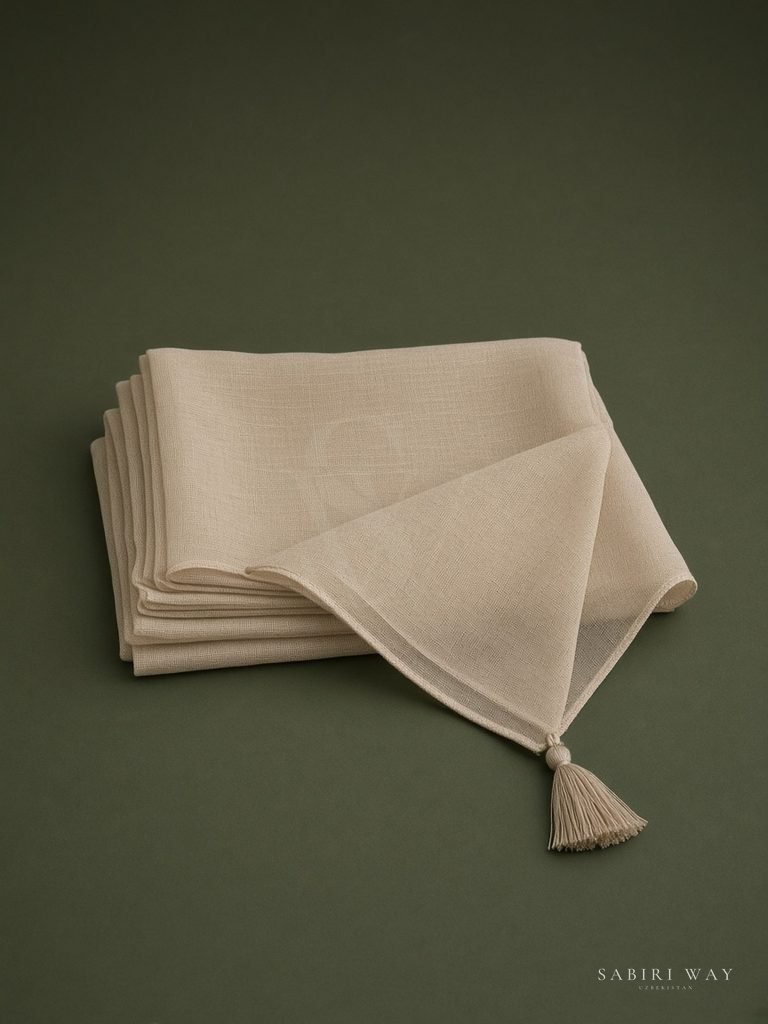
Katta roʻmol shawl
A 140 × 140 cm square shawl-headscarf that drapes as a hijab or over the shoulders, with hand-rolled edges and short tonal tassels at the corners.
Composition: 70% cotton / 30% silk voile · recommended
Heritage source: In the Fergana Valley it was considered a sin to go out without a headscarf: women wore large kerchiefs folded on the diagonal, and in the early 20th century large silk ‘gijim rumol’ kerchiefs with tassels came into fashion.2
Stone BeigeCharcoalClassicHR-11 · Fergana · Samarkand
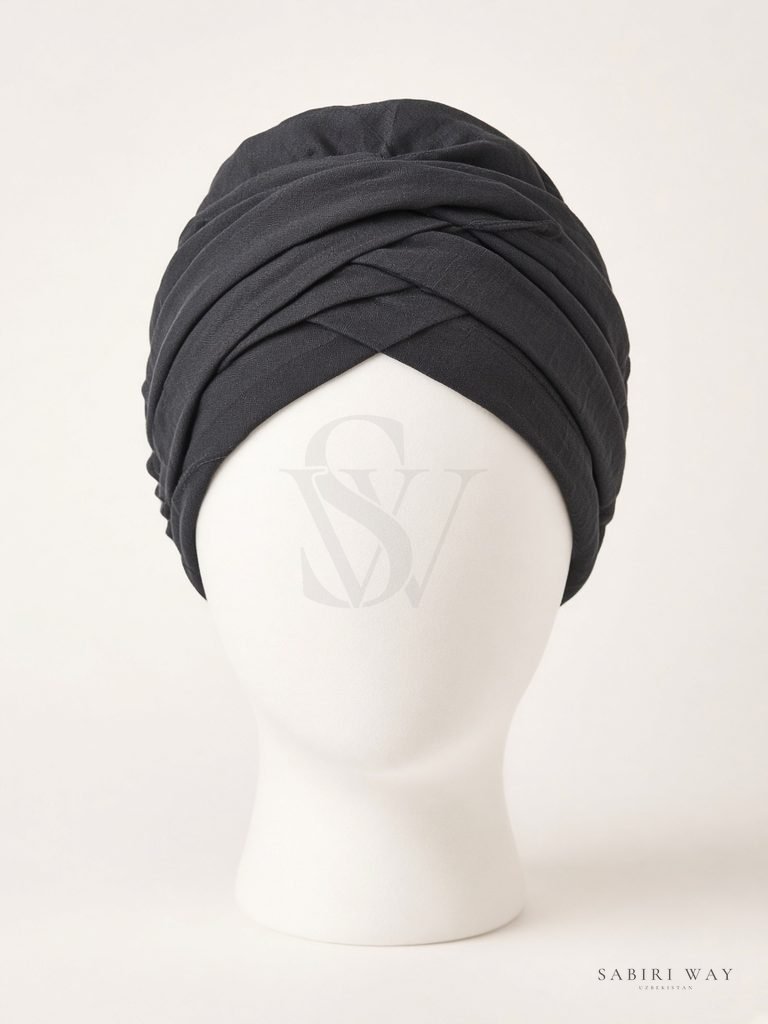
Durra turban-wrap
A pre-shaped soft turban that sits high at the forehead and covers the crown: a jersey inner cap with woven outer folds stitched in place, so no pins are needed.
Composition: Inner cap: 95% cotton / 5% elastane jersey; outer: 100% cotton voile · recommended
Heritage source: Fergana ‘durra’: a small kerchief folded several times and fixed over the main scarf like a high tiara at the forehead; in Samarkand the turban-like ‘loki’ was the most ancient women’s headwear.21
CharcoalCotton WhiteSemi-classicHR-12 · Kashkadarya
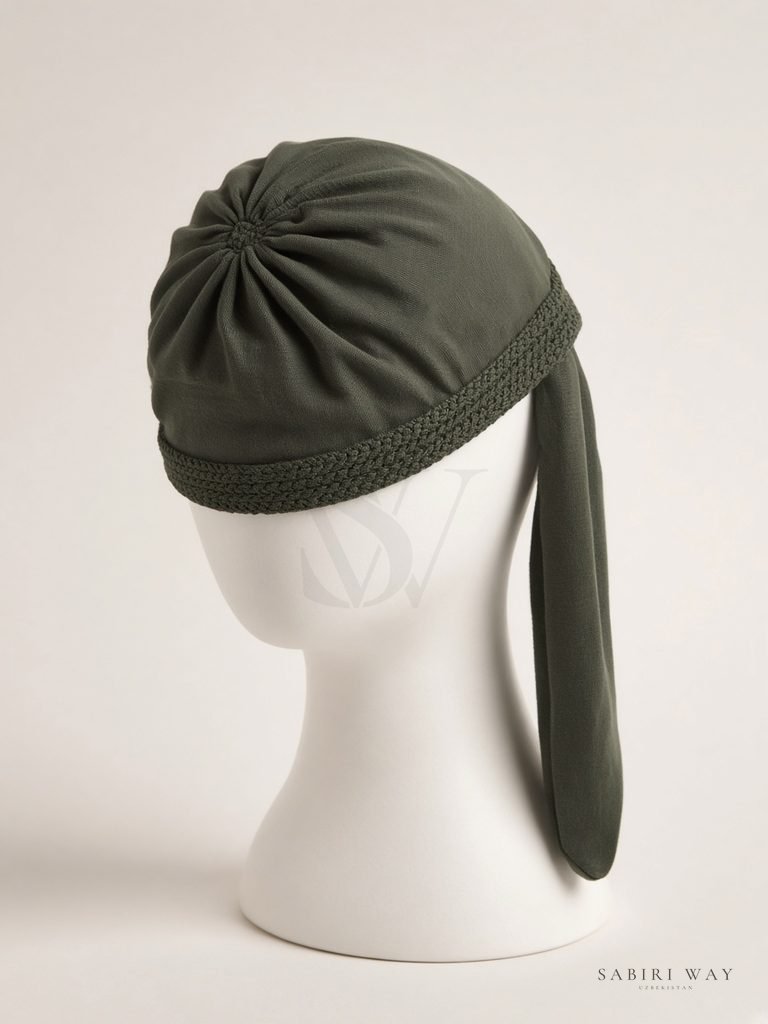
Kulta cap
A soft round under-scarf cap with a gathered crown and a long tubular back panel that holds the hair or a braid; tonal braid at the band keeps any scarf in place.
Composition: 95% cotton / 5% elastane jersey · recommended
Heritage source: Kashkadarya ‘kulta’ (kijigich): a round cap bordered with braid, with a gathered top and a braid-holder hanging at the back.4
Dark OliveCharcoalSemi-sport
Footwear
Three models and two sets — choose yours
Mahsi with an inner zip. Kavush with a short front. Kafsh with a long, high front. All three: orthopedic-shaped footbed with arch support and heel cup, memory foam + EVA, natural leather lining, flexible non-slip sole. Or take mahsi with kavush or kafsh as a set.
HR-13 · Model
Mahsi
An ankle-high soft sock-boot in genuine leather or eco-leather (PU) with a 12 cm inner side zip for easy on/off, natural leather lining, orthopedic-shaped removable footbed and a soft 2.5–3 mm leather sole stitched on the side wall, with no heel and no hard counter, as tradition has it: worn alone indoors, or inside a kavush or kafsh one size up outdoors.
Composition: Genuine cowhide nappa, 0.9–1.1 mm · or PU eco-leather
Sizes: EU 35–42 ·
HR-18 · Model
Kavush
A traditional kavush (galosh) with a rounded, slightly upturned toe, a SHORT front (4 cm at mid-foot) and a low 4.5 cm back, as in the Tashkent zaifona kavush: it slips on over mahsi in a second; orthopedic-shaped footbed, natural leather lining, seamless moulded non-slip sole with a 2 cm heel.
Composition: Genuine cowhide, 1.2–1.4 mm · or PU eco-leather
Sizes: EU 35–42 ·
HR-20 · Model
Kafsh
A backless mule with a LONG high front: the vamp covers the whole instep (9 cm), so the foot is held securely and stays covered; orthopedic-shaped footbed, natural leather lining, seamless moulded non-slip sole with a 2 cm heel; worn over mahsi one size up.
Composition: Genuine cowhide, 1.2–1.4 mm · or PU eco-leather
Sizes: EU 35–42 ·
HR-19 · Set
Set: mahsi + kavush
Mahsi with zip (HR-13) and short-front kavush (HR-18) in one colour; the kavush is cut one size roomier to go over the mahsi.
Composition: Genuine cowhide nappa, 0.9–1.1 mm · or PU eco-leather
Sizes: EU 35–42 ·
HR-21 · Set
Set: mahsi + kafsh
Mahsi with zip (HR-13) and high-front Kafsh (HR-20) in one colour; the kafsh is cut one size roomier to go over the mahsi.
Composition: Genuine cowhide nappa, 0.9–1.1 mm · or PU eco-leather
Sizes: EU 35–42 ·
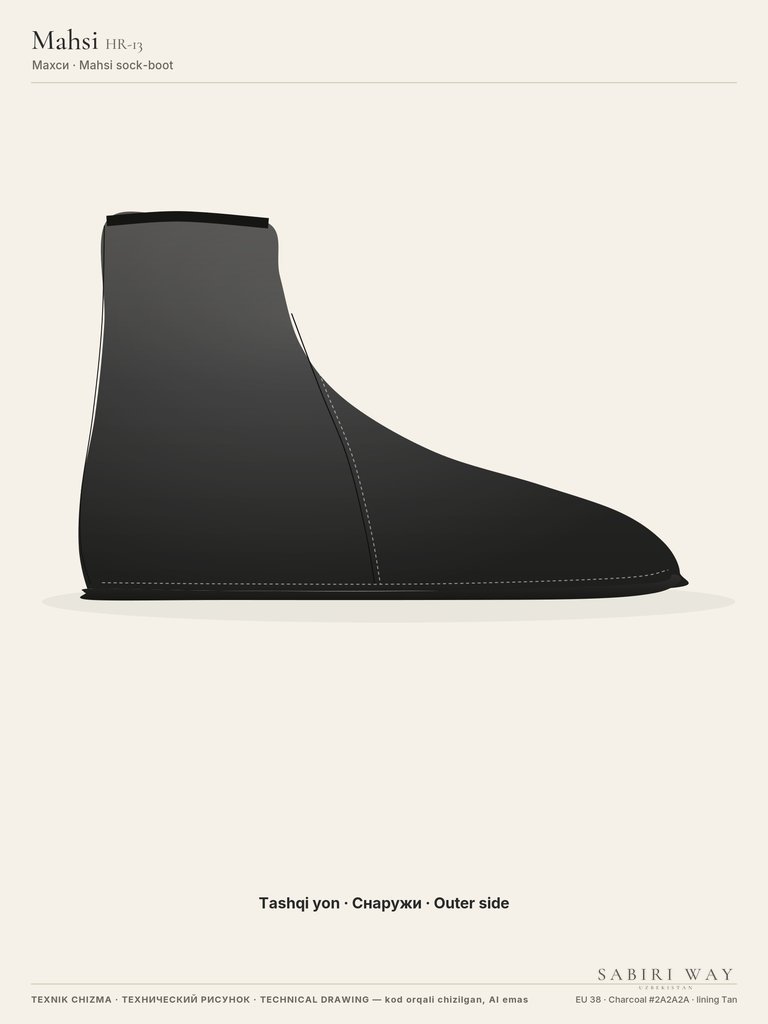
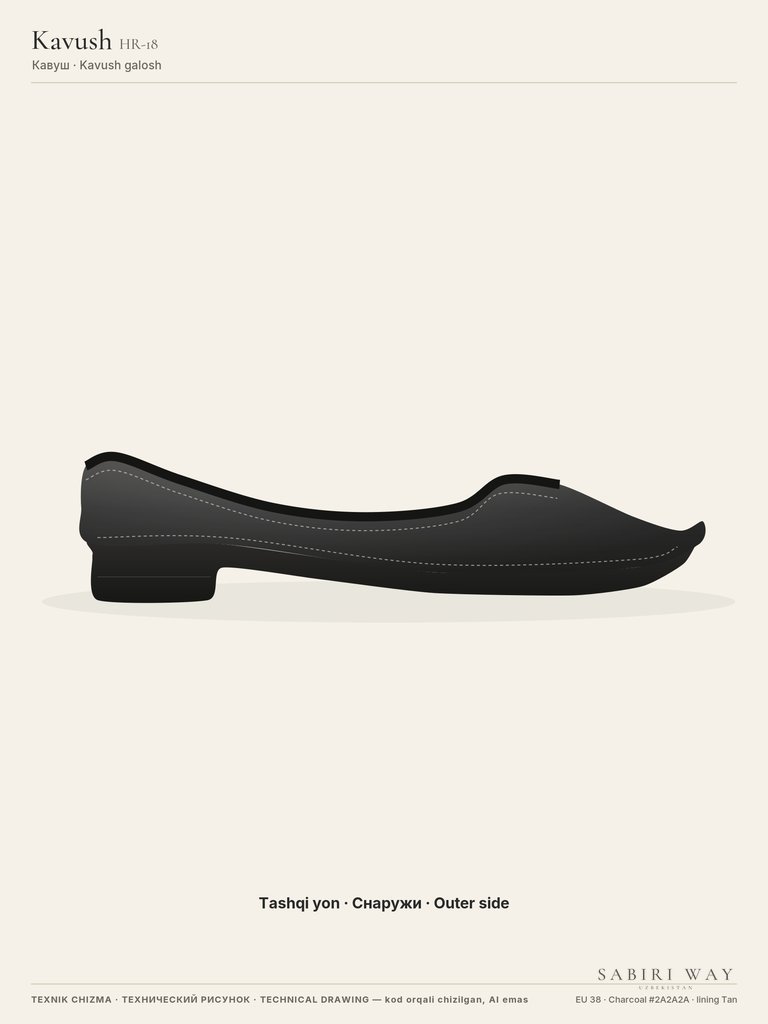
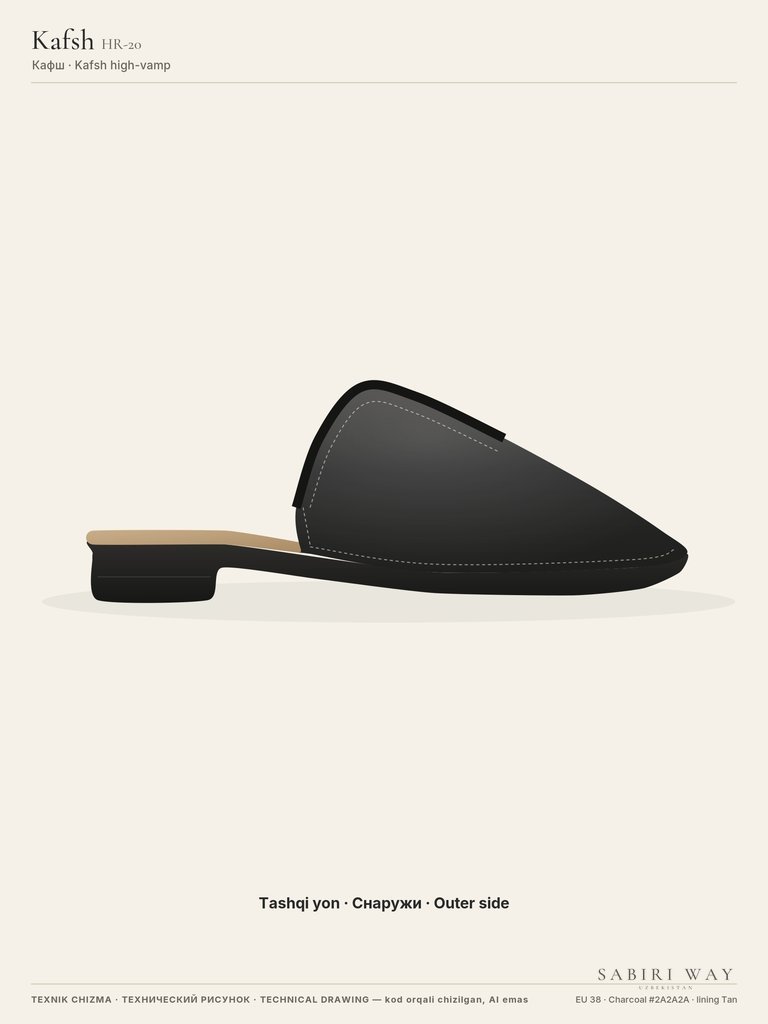
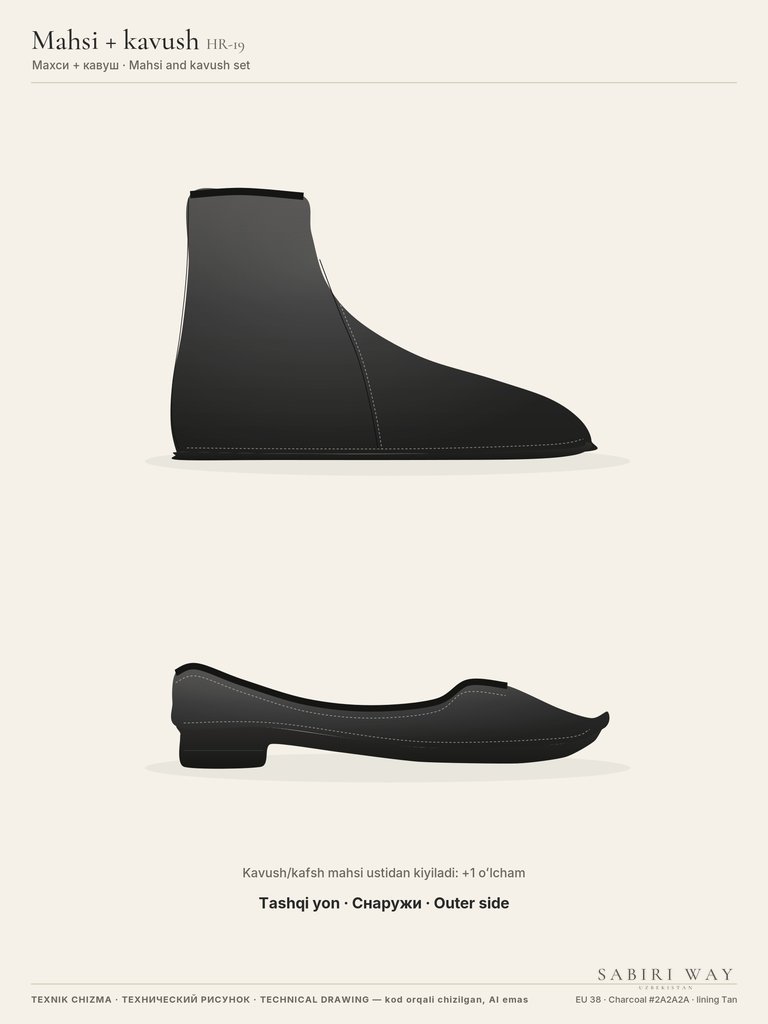
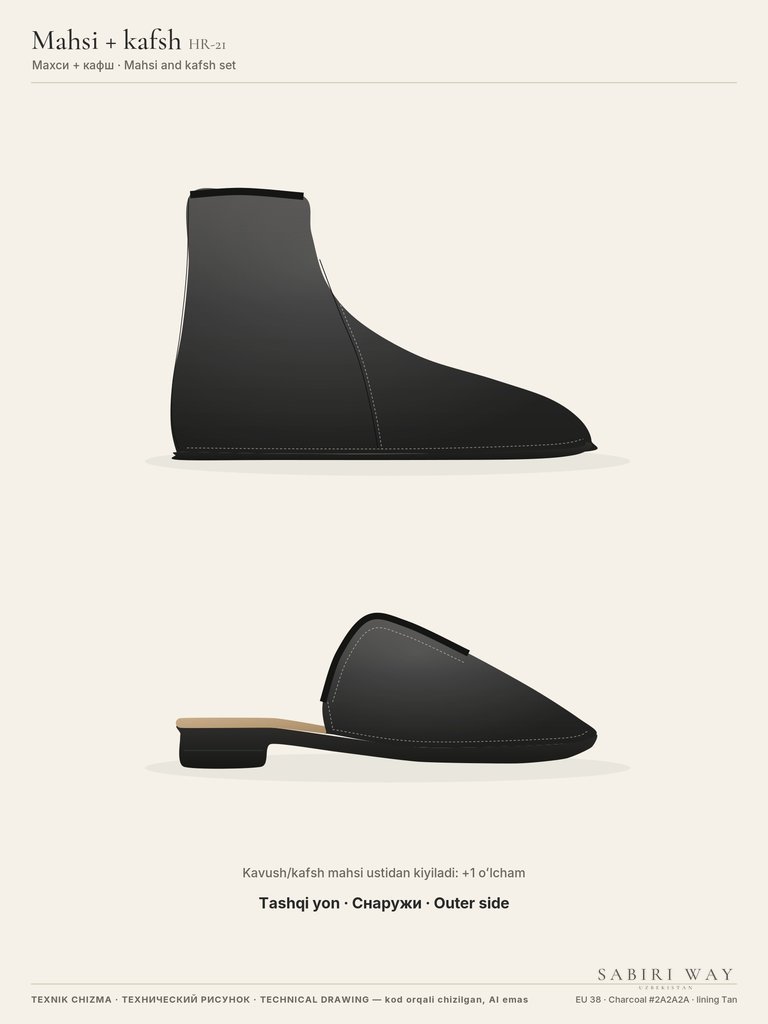
Traditional construction: soft mahsi without heel or hard counter; kavush and kafsh worn over it. Images are technical drawings made in code, not AI and not photos; sole and fit are confirmed on the first sample last.
Accessories
Tasbih, bags and small leather goods.
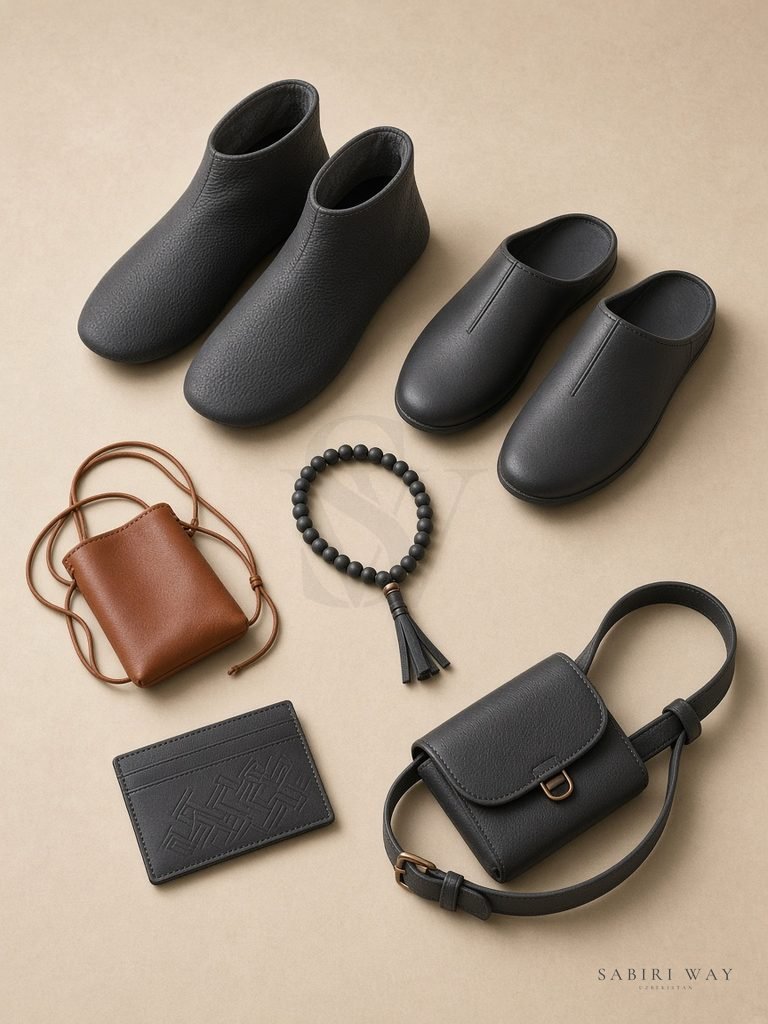
HR-14 · Across Uzbekistan
Tasbih, 33 beads
33 matte charcoal wooden beads with one copper-tone spacer and a short leather tassel, kept in a small leather pouch.
Composition: Hardwood (beech or similar), charcoal stain, matte water-based lacquer, 8 mm · recommended
Heritage source: The tasbih (misbaha): prayer beads used for dhikr, commonly with 33 or 99 beads, made of wood, stone, seeds and other materials.13
CharcoalClassicHR-15 · Fergana
Peshauz pouch
A small copper-colour leather pouch on a long adjustable cord, with a key ring inside: like the peshauz, it keeps the essentials close.
Composition: Genuine cowhide, 1.2–1.4 mm, or PU eco-leather · recommended
Heritage source: Fergana women attached a silver ‘peshauz’ pendant to the dress tassel at the waist; tweezers, a toothpick, a perfume bottle and keys were fastened to it.2
CopperSemi-sportHR-16 · Kashkadarya · Surkhandarya
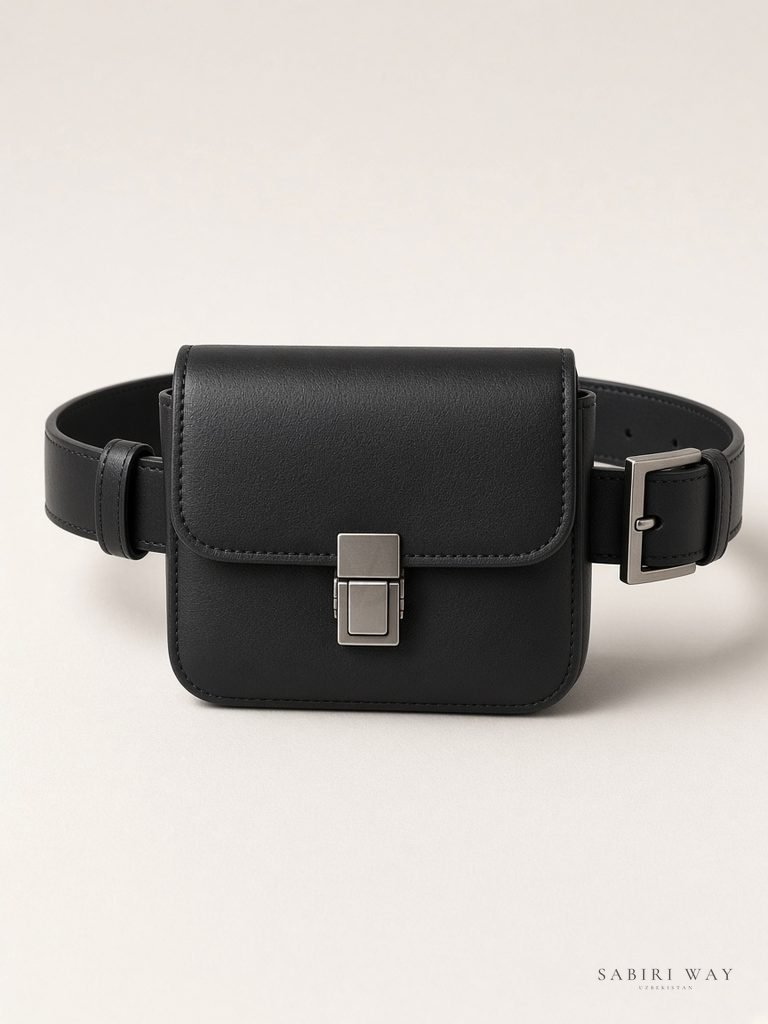
Belbogʻ belt bag
A slim leather belt with a detachable flap bag: no stones, one brushed metal closure.
Composition: Genuine cowhide, 1.6–1.8 mm (belt 3.0 mm), or PU eco-leather · recommended
Heritage source: In Kashkadarya and Surkhandarya purses, knives and bags were hung on the belt; leather belts were decorated with coloured stones.5
CharcoalSemi-sportHR-17 · Kashkadarya
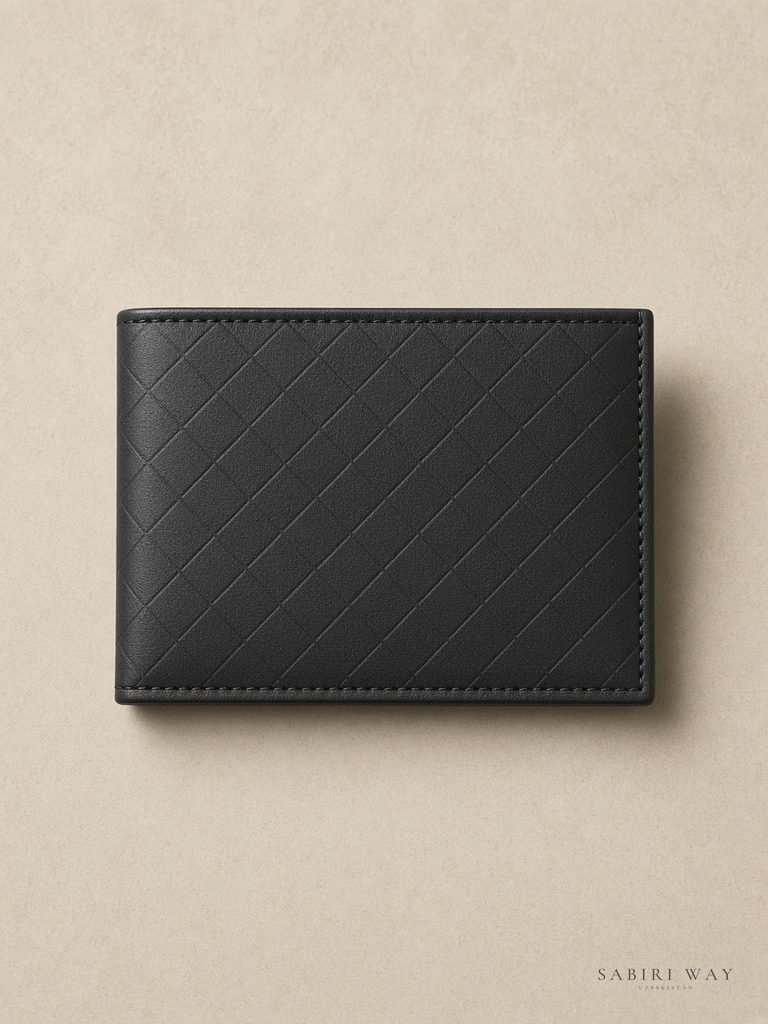
Iroki card holder
A slim four-slot leather card holder with an iroki diamond grid debossed tone on tone: no ink, no foil.
Composition: Vegetable-tanned cowhide, 1.0–1.2 mm, unlined, painted edges · recommended
Heritage source: Iroki: the dense, carpet-like stitch of Kashkadarya, used on headdresses and on the edges of women’s head-cloaks.4
CharcoalCopperClassic
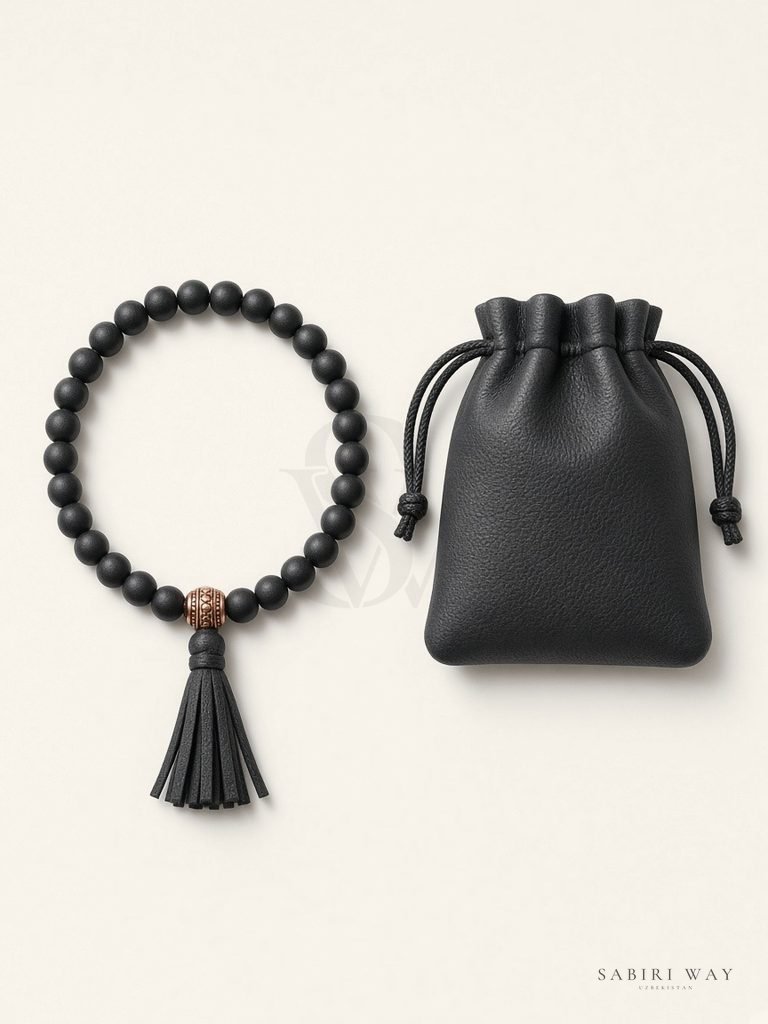
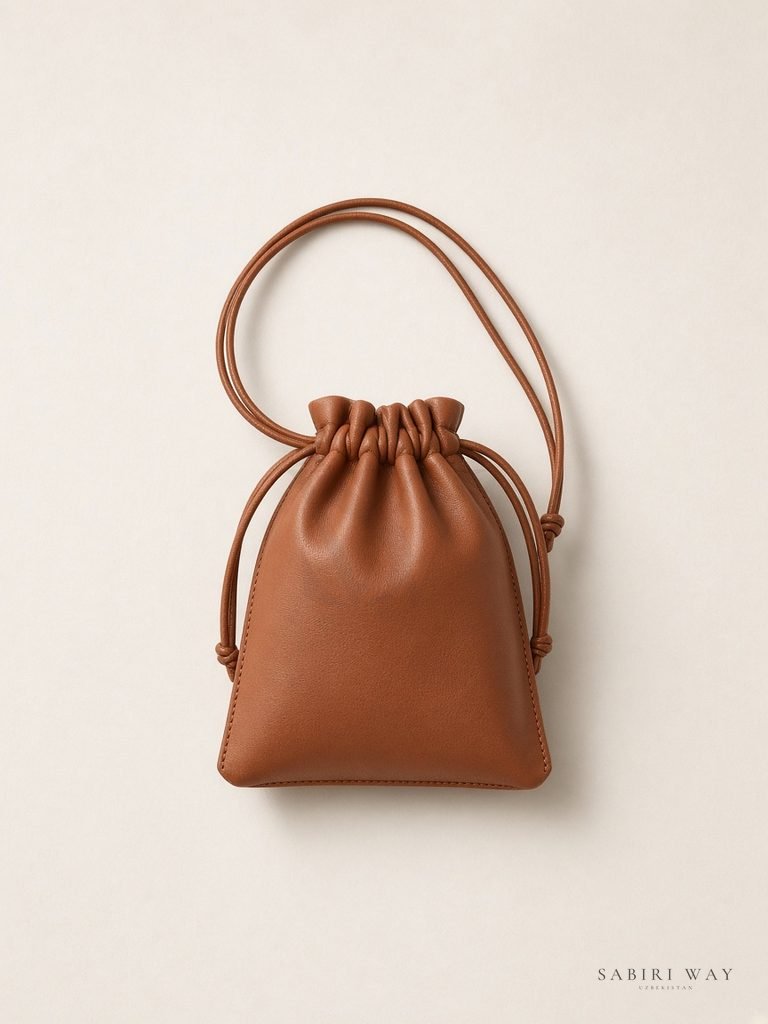
Prices: [to be completed] · Sizes: SABIRI WAY standard v1 — finalised after first sample fitting · All photos, including product packshots, are AI visualisations with fictional models; compositions are recommended values, final per supplier certificate.
Sources
- Binafsha Nodir, ‘The national costume of the Samarkand women at the end of the 19th – 20th cc.’, San’at, 2004, No. 3–4
- Zuhra Rakhimova, ‘Traditional Female Clothes (end of XIX – beginning of XX centuries)’ [Fergana Valley], San’at, 2012, No. 3
- Binafsha Nodir, ‘Traditional Costume of Uzbek Women of the Late 19th and 20th Centuries: Khorezm’, San’at, 2009, No. 4
- Binafsha Nodir, ‘Traditional Kashkadarya Female Clothing of the First Half of the 20th Century’, San’at, 2005, No. 2
- ‘Uzbek National Costume of Kashkadarya–Surkhandarya in the Early XIX–XX Centuries’, JournalNX, vol. 9, no. 5, 2023
- ‘Traditional Costume of Boysun Women’, San’at, 2006, No. 2
- The Bukhara Museum, collection highlights: Clothes
- Intangible Cultural Heritage of Uzbekistan, national list: Zardozlik (gold embroidery)
- Saodat Davlatova, ‘From the History of the Evolution of Uzbek National Costume’, San’at, 2006, No. 3–4
- ‘What was included in a woman’s costume in Tashkent?’, Society.uz, 5 Dec 2023
- Russian Museum of Ethnography, ‘Karakalpaks. Women’s headdresses’, 2022
- ‘Karakalpak Jegde’, karakalpak.com
- ‘Misbaha’, Wikipedia